
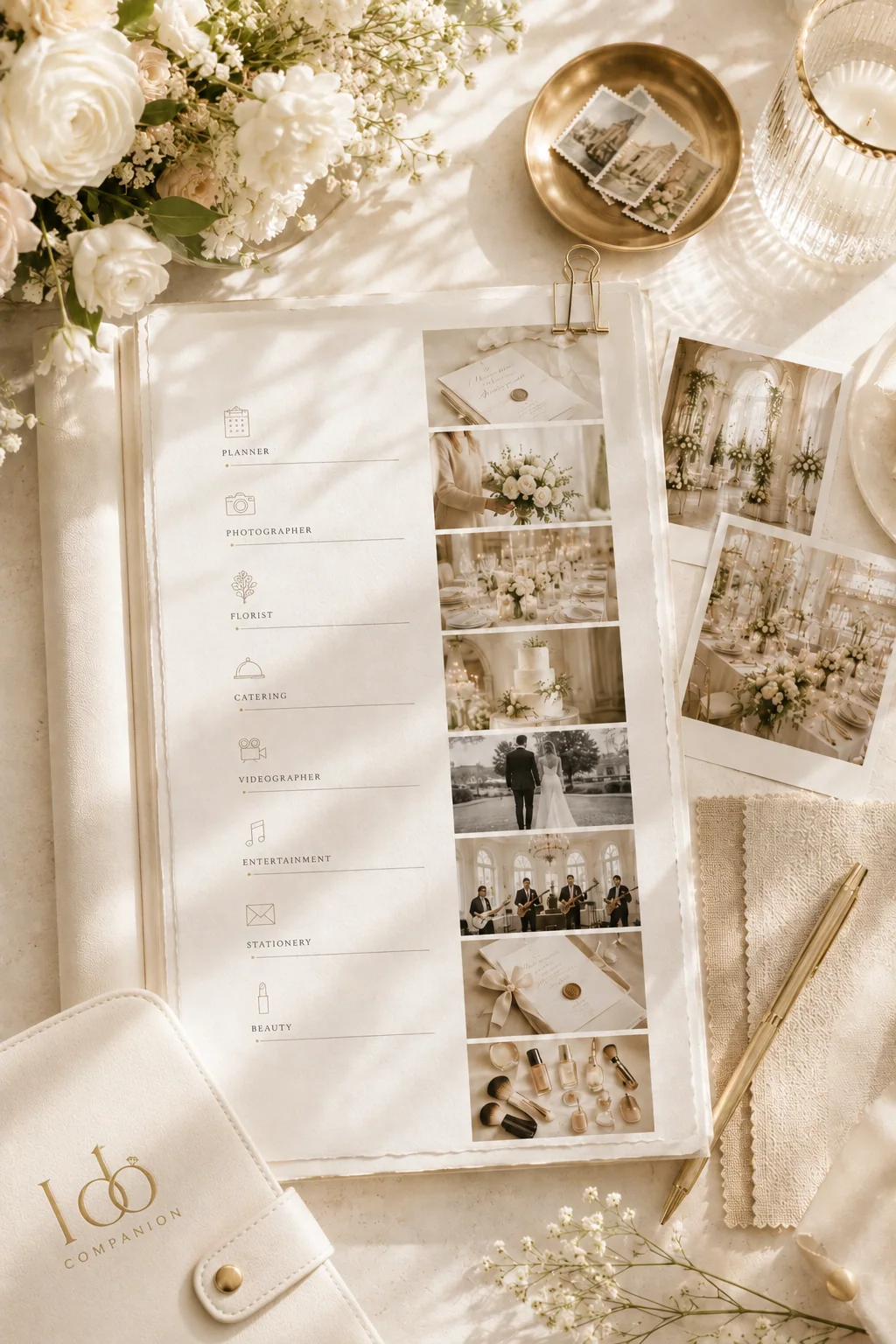
Most couples spend more time researching their honeymoon hotel than the photographer who will spend twelve hours with them on the most photographed day of their life. Vendor selection is the highest-stakes research project in wedding planning. It's also the one most couples approach without a system. Here's one.
The order vendors should be booked in
Vendor categories have different lead times and different downstream dependencies. Book in this order:
- Venue. 10-14 months out. Sets your date, capacity, and many other constraints.
- Photographer + videographer. 9-12 months out. Top photographers in your region book out quickly.
- Caterer (if not venue-included). 9-12 months out.
- Officiant. 8-10 months out. Often overlooked until late and then panicked-about.
- Florist. 6-9 months out. After you have venue dimensions and a general aesthetic direction.
- DJ or band. 6-9 months out.
- Hair + makeup. 4-6 months out.
- Stationery. 4-6 months out for save-the-dates; 2-3 months out for invitations.
- Cake. 3-4 months out.
- Transportation. 2-3 months out.
If you're getting married in under 8 months, condense the schedule but keep the order. The categories at the top depend on each other; don't pick a florist before you know your venue.
The six-step framework
Apply this framework to each major vendor category. It looks like a lot of steps; it's actually faster than rabbit-holing on a single Instagram account for an hour.
Define your style + budget before opening Instagram.
Write down, in one sentence each, your aesthetic direction (e.g., “garden romance, soft greenery, candlelit”) and your budget range for this vendor category. Do this BEFORE searching. Otherwise you'll fall in love with a $12,000 florist when your budget is $3,000.
Build a shortlist of five to eight options.
Sources: published reviews, your venue's preferred vendor list, recommendations from your photographer (or other vendors you've already booked), and 2-3 names from Instagram or wedding sites you genuinely connect with. Five to eight is the right number. Three is too few. Twelve is too many.
Cut to three based on style fit + budget.
Look at full galleries (not curated portfolios) on the vendor's website. Most vendors publish blog posts of recent weddings. Look at three full weddings from each. Cut anyone whose style doesn't actually match yours, even if their highlight reel is beautiful. Verify they're in your budget range with a quick inquiry email.
Talk to all three. Phone or video, not email.
A 20-minute conversation tells you more than 50 emails. You're hiring someone who will be present at your wedding; you need to know how it feels to talk to them. Pay attention to how they listen, how they ask questions about you, and whether they answer specifically or generically.
Read third-party reviews for any concerns.
Search the vendor's name on Google, The Knot, Yelp, and Reddit. Pay attention to negative reviews (everyone has some). What you're looking for is patterns, not isolated complaints. If three different couples mention the same issue (late arrivals, missed shots, communication problems), it's real.
Book your favorite, read the contract carefully.
Most vendor contracts are standard, but read every clause. Pay particular attention to cancellation windows, what happens if the vendor can't perform, deposit refundability, and overtime/extra-hour rates. Ask about anything that's unclear before you sign.
A 20-minute conversation tells you more than 50 emails. You're hiring someone who will be present at your wedding.
Questions to ask before signing a contract
The questions vary by category, but here's a core set that applies to almost every vendor:
- How many weddings do you book in a typical year? In a typical weekend? Tells you their experience level and whether you'll be one of three weddings they're juggling that day.
- What happens if you can't be there? Illness, family emergency, double-booking. The answer should involve a named backup, not “we'll figure it out.”
- What's your cancellation and refund policy? For both you cancelling and them cancelling.
- What's included in the price, and what costs extra? Especially overtime, travel, extra staff, additional revisions.
- When do I receive [final photos / final video / leftover florals / etc.]? Get a written timeline, not “soon after the wedding.”
- Can I see a full wedding gallery from a recent event similar to mine? Highlight reels lie. Full galleries don't.
- What does your day-of communication look like? Who handles questions, who arrives when, how reachable are you the week of the wedding.
Red flags to walk away from
Six warning signs that show up early. Trust them.
- They take more than 5 business days to respond to your initial inquiry. If they're slow now, they'll be slow when you have an urgent question 3 weeks before the wedding.
- They won't put pricing in writing until a meeting. Some discretion is normal; refusing to share any range without a sales pitch is a red flag.
- They pressure you to book before you're ready. “Other couples are looking at this date” is a sales technique. Don't book under pressure.
- Multiple recent reviews mention the same issue. One unhappy customer is normal; three mentioning the same problem is a pattern.
- The portfolio they show you doesn't match what's on their public site. If you only see beautiful work in person and average work on their public Instagram, something's off.
- They speak negatively about other vendors in your area. Professionals don't tear down peers. It signals insecurity and predicts how they'll behave under pressure.
Choosing for style versus skill
For some vendor categories, style matters most (photographer, florist, stationery). For others, skill matters most (DJ, caterer, hair and makeup). Don't confuse the two.
With photographers, the best technical skill in the world won't save a portfolio whose style doesn't match yours. You'll feel it every time you look at the photos for the next 50 years. Style fit is the criterion.
With DJs and caterers, the work happens in real-time and the skill of execution is what determines whether your guests have a great time. A DJ with a slightly less polished aesthetic but extraordinary skill at reading rooms will deliver a better wedding than a beautiful brand with weak execution.
Knowing which axis matters for which category prevents you from over-weighting the wrong thing.
When to let someone else compare for you
The hardest part of vendor selection isn't the research; it's the comparison. When you've gathered three quotes, three portfolios, three contracts, three sets of reviews, the synthesis can feel paralyzing. Some couples lean on a wedding planner. Some lean on a friend who's been through it. Some use a structured tool to lay everything side-by-side.
However you do it, get a second perspective before you commit. The hours you spent staring at portfolios make you the worst person to evaluate them objectively at the end.
Vendors will shape your wedding day more than any other single category of decision. Hire deliberately, ask the right questions, and trust your gut when something feels off. The couples who later say “we got really lucky with our vendors” almost always have a system underneath the luck.